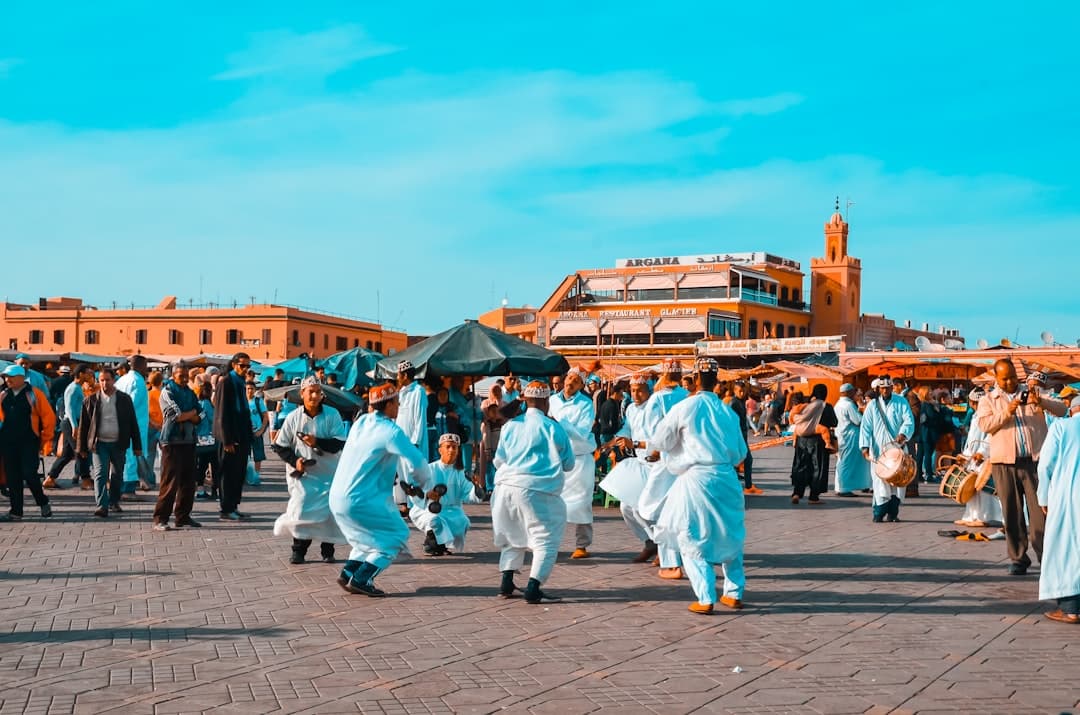
Three months ago, I found myself wandering through the bustling streets of Marrakech during the Festival National des Arts Populaires. The air was filled with the intoxicating blend of spices and melodies, a sensory overload that was as overwhelming as it was captivating. I had been invited to explore the rich tapestry of Moroccan music, specifically focusing on the evolution from chaâbi to gnawa. It was a project I was passionate about, but also one that made me question my own understanding of cultural heritage.
As I stood there, absorbing the vibrant energy, a local musician approached me. "You're the expert from France, right?" he asked with a warm smile. I nodded, slightly embarrassed by the title. "Come, let me show you something," he said, gesturing towards a small courtyard where a group of musicians were gathered. This is where my real journey began.
The courtyard was alive with the sounds of a chaâbi performance. The musicians played with such fervor that it was impossible not to be swept up in their enthusiasm. I watched as people clapped and danced, their joy infectious. It was in that moment that I realized the true power of music to unite people, transcending language and cultural barriers.
But it wasn't all smooth sailing. As the festival progressed, I found myself struggling to reconcile the traditional sounds with their modern interpretations. I met with a young band who were infusing electronic beats into traditional gnawa music. They were passionate and innovative, but part of me worried that something was being lost in the process. "Isn't there a risk of losing the essence?" I asked one of the band members, a young man with dreadlocks and a wide grin. He shrugged, "We're not losing it, we're evolving it."
This insight shifted my perspective. The modernization wasn't a threat; it was a continuation of the story. Yet, there was a part of me that still felt uneasy. Was it really possible to preserve the soul of these ancient melodies while adapting to contemporary tastes?
I spent the next few days immersed in workshops and performances, speaking with artists and historians alike. I learned about the strict traditional practices in gnawa music, such as the use of the guembri and qraqeb, and how these instruments are integral to maintaining the spiritual essence of the genre. Yet, I also saw how younger artists were bridging gaps, using their platforms to introduce these sounds to global audiences.
The festival culminated in a grand performance where traditional chaâbi and modern gnawa were played side by side. It was a harmonious blend, a testament to the resilience and adaptability of Moroccan music. As I watched, I felt a sense of peace. The music wasn't just surviving; it was thriving.
Frequently Asked Questions
What is the main difference between chaâbi and gnawa music?
Chaâbi is often referred to as the music of the people, typically played at celebrations and in markets. It draws from a variety of influences including Andalusian and Berber melodies. Gnawa, on the other hand, has spiritual roots, originating from the sub-Saharan region. It incorporates ritualistic elements and is often used in healing ceremonies.
How are modern artists blending traditional Moroccan music with contemporary sounds?
Many modern artists are experimenting by adding electronic beats and modern instruments to traditional Moroccan music. This fusion allows them to reach a wider audience while maintaining the cultural essence. Examples include bands like Innov Gnawa, who have performed internationally and received acclaim for their innovative approach.
Is there resistance to modernizing traditional music in Morocco?
Yes, there is some resistance, particularly from purists who fear that modernization might dilute the cultural significance. However, many artists argue that evolution is necessary for survival and relevance in the modern world.
What role do festivals play in preserving and promoting Moroccan music?
Festivals like the Festival National des Arts Populaires play a crucial role in showcasing both traditional and modern interpretations of Moroccan music. They provide a platform for artists to perform, collaborate, and exchange ideas, thus ensuring the continuity and innovation of the musical heritage.
What has been the international impact of Moroccan music?
Moroccan music has had a significant impact internationally, influencing genres ranging from jazz to electronic music. Artists like Jimi Hendrix and Led Zeppelin have drawn inspiration from Moroccan sounds, and the global interest in world music continues to grow, with Moroccan artists gaining recognition on international stages.
Reflecting on this experience, I realize that there were moments where I could have embraced the changes more openly. Initially, my purist perspective clouded my judgment, but witnessing the passionate creativity of young artists taught me the value of adaptability. If I were to do it again, I'd focus more on the dialogue between tradition and innovation, understanding that both are essential to the survival and growth of cultural heritage.
In the end, the story of Moroccan music is one of resilience and transformation, a reminder that culture is not static but a living, breathing entity capable of inspiring generations.
- Tags:* #MoroccanMusic #Chaâbi #Gnawa #CulturalHeritage #MusicEvolution